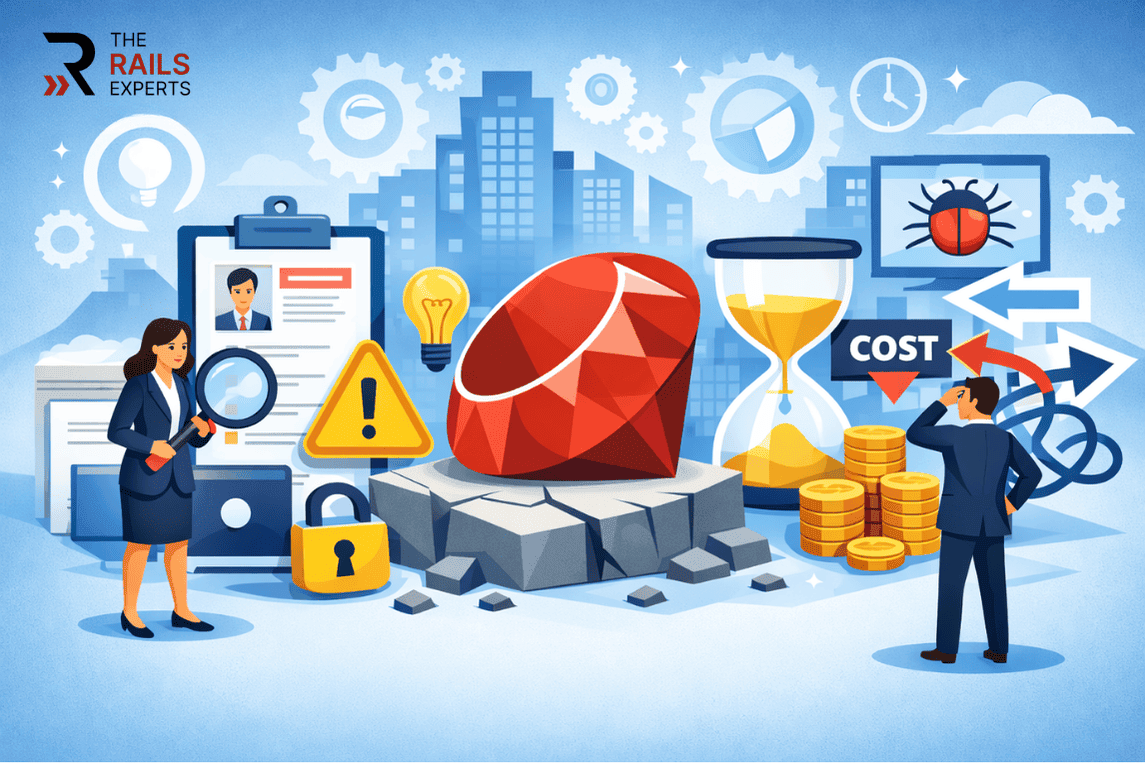
Hiring a Ruby on Rails developer may seem simple at first, but real challenges quickly emerge. It can be difficult to assess true technical depth, justify varying cost expectations, and ensure alignment with your product’s complexity. Concerns around scalability, security, and long term maintainability often make the decision feel high risk.
With strong experience in building and scaling Rails based applications, we understand how hiring decisions directly impact business outcomes. Our approach focuses not just on coding ability, but on architecture, communication, and sustainability to ensure long term success.
In this article, you will discover five key business challenges in hiring Ruby on Rails developers and practical ways to navigate them with confidence.
1. Balancing cost with true expertise
Experienced Ruby on Rails developers typically command higher rates. Their pricing reflects years of architectural decision making, production deployment experience, and the ability to anticipate scalability issues before they occur.
For startups and growing businesses, this creates tension between budget discipline and technical strength. Choosing a lower cost developer may appear financially responsible at first. However, weak architecture, inefficient database design, or overlooked performance bottlenecks can generate technical debt that becomes expensive to correct later.
How to navigate this challenge
Shift your evaluation from hourly cost to long term value. Ask:
- Have they built applications similar to your industry or scale
- Can they explain architectural tradeoffs clearly
- Do they understand business metrics beyond code delivery
A developer who builds clean, maintainable systems from the start often reduces total ownership cost. If budgets are constrained, define a phased roadmap or clear MVP scope instead of compromising on capability.
2. Misalignment between project complexity and skill depth

Not all Ruby on Rails developers bring the same level of expertise. Some specialize in building standard CRUD based business applications. Others have experience with complex APIs, background job processing, caching strategies, high traffic systems, or advanced integrations.
Hiring someone whose experience does not match your product complexity can result in scalability issues, unstable integrations, or inefficient architecture.
How to reduce mismatch risk
Go beyond surface level technical questions. Instead:
- Ask candidates to describe architectural decisions from previous projects
- Present a real world scenario relevant to your product
- Explore how they handled performance bottlenecks or refactoring
Strong developers think at a system level. Their answers demonstrate structured reasoning, awareness of tradeoffs, and long term planning rather than feature level execution alone.
Document your own technical expectations before interviews begin. Clear scope clarity reduces confusion during evaluation.
3. Collaboration challenges in distributed environments
Remote hiring expands access to global talent, but it also introduces coordination complexity. Differences in time zones, communication styles, and documentation habits can affect sprint velocity and clarity.
Without structured processes, misunderstandings accumulate. Informal collaboration models that work in office settings often fail in distributed teams.
How to strengthen collaboration
Define operational standards early:
- Clear communication channels
- Defined response time expectations
- Written documentation protocols
- Transparent sprint planning
Encourage written updates and task clarity to reduce dependency on real time meetings. When expectations are structured, remote collaboration becomes predictable and accountable.
4. Security and data protection oversights
Modern applications frequently manage sensitive user data, payment details, or proprietary information. Security weaknesses introduced during development may not be visible immediately, but they can create significant financial and reputational damage later.
Some developers prioritize rapid feature delivery over layered security implementation. Authentication logic, data validation, and third party integrations require disciplined execution.
How to evaluate a security mindset
During interviews, explore how candidates approach protection:
- How do they safeguard sensitive data
- What testing processes do they follow before deployment
- How do they stay informed about emerging vulnerabilities
Developers with a mature security mindset treat protection as foundational rather than optional. Enterprise security standards published by the National Institute of Standards and Technology, such as NIST SP 800-53 outline structured control frameworks that reinforce this disciplined approach to safeguarding applications.
Establishing security checkpoints within your development workflow ensures it remains embedded throughout the lifecycle.
5. Maintaining code quality for long term stability
Launching a product is only the beginning. Over time, new features are added, traffic increases, and integrations expand. Poorly structured code makes even small updates slow and risky.
When hiring prioritizes speed over discipline, testing and documentation often suffer. This leads to fragile systems that require constant correction.
How to safeguard long term quality
Assess methodology, not just output. You can reference the official Rails Testing Guide to understand recommended conventions around testing, structure, and long term maintainability.
Ask questions such as:
- How do they organize application structure
- What is their testing strategy
- Do they write documentation consistently
- How do they approach refactoring
Request code samples or practical assignments to evaluate readability, clarity, and architectural discipline. Developers who emphasize maintainability think beyond immediate deadlines and design systems that remain stable as they evolve.
Common hiring mistakes that increase business risk
Even when strong candidates are available, internal hiring practices can create failure points. Companies often:
- Rush recruitment due to time pressure
- Focus only on technical ability while ignoring communication skills
- Fail to define clear project scope
- Prioritize short term cost savings over long term value
- Skip structured evaluation frameworks
A deliberate and documented hiring process significantly reduces uncertainty and protects your investment.
Should you hire an individual Rails developer or a team
For well defined, limited scope projects, an experienced individual developer may be sufficient. However, larger or evolving platforms often benefit from a coordinated development team.
Teams introduce peer review, shared accountability, structured processes, and continuity if one member becomes unavailable. This added oversight often improves reliability and long term maintainability.
The right choice depends on your product roadmap, expected growth, and operational complexity.
Building a strong foundation for your Rails project
Hiring a Ruby on Rails developer means choosing a strategic partner who will shape your product’s architecture, scalability, and long term stability. The right decision reduces risk and supports sustainable growth.
By clearly defining expectations around cost, technical depth, collaboration, and quality standards, you turn hiring into a controlled business investment rather than a reactive choice.
If you are planning a Rails project and want clarity before you hire, connect with our team to discuss the right development approach for your goals.
