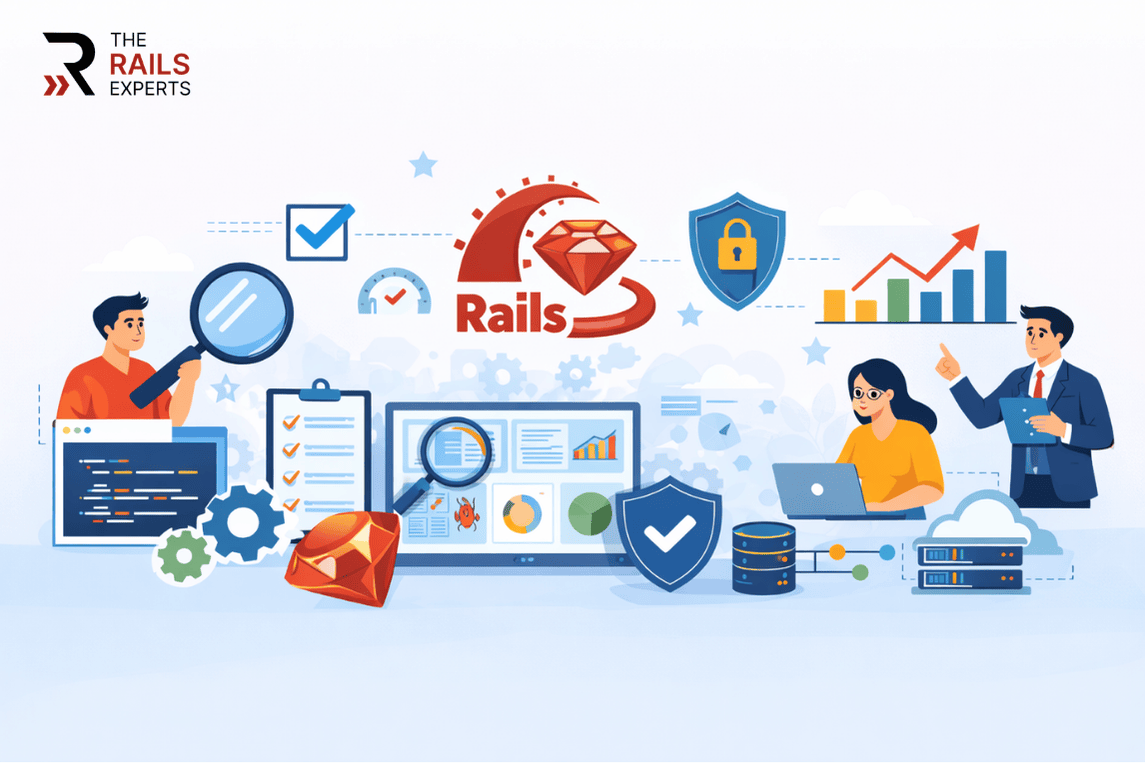
How prepared is your Ruby on Rails project for growth and scale? Many applications appear stable on the surface while deeper architectural issues, inefficient database usage, or limited test coverage gradually increase technical debt. Eventually, this affects speed, cost, and stability.
A structured evaluation helps you move beyond surface functionality and examine architecture, performance, security, and long term sustainability.
In this article, you will learn how to assess your Rails project from both technical and business perspectives to plan growth with confidence.
What should you evaluate in a Ruby on Rails project?
A thorough evaluation goes beyond checking whether the application works today. It focuses on sustainability, scalability, and risk exposure over time.
You should assess:
- Code structure and maintainability
- Performance and database efficiency
- Test coverage and reliability
- Security vulnerabilities
- Scalability readiness
- Development workflow and deployment process
Each of these areas directly impacts long term development cost, release velocity, and operational stability. Ignoring even one can gradually weaken the overall system.
How do you assess code quality in Rails?
Code quality determines how easy your application is to modify, extend, debug, and onboard new developers into.
Start with static analysis tools such as RuboCop, Reek, or RubyCritic. These tools highlight code smells, stylistic inconsistencies, duplicated logic, and structural complexity. While they do not replace architectural review, they quickly expose maintainability risks.
Next, examine architectural discipline. Controllers should remain lightweight and focused on request handling, following the conventions outlined in the official Ruby on Rails Guides. Business logic should live in appropriate layers such as services or models. When models become excessively large or logic is scattered across views, long term maintainability suffers.
Measure complexity using metrics like cyclomatic complexity, method length, and class size. Extremely long methods or deeply nested conditionals often signal refactoring opportunities. Clean, modular code improves readability, accelerates feature delivery, and reduces regression risk.
How can you measure performance and database health?
In many Rails applications, database inefficiency becomes the primary bottleneck as usage grows.
Look for N+1 queries, missing indexes, unnecessary eager loading, and slow reporting queries. The Bullet gem helps detect inefficient query patterns during development. Database monitoring tools such as PG Hero provide insight into slow queries, index usage, and overall schema health.
Beyond the database, use application performance monitoring tools such as New Relic or Datadog to track response times, memory usage, throughput, and error rates in production. Real world monitoring often reveals bottlenecks that local testing cannot simulate.
Performance evaluation should reflect actual user behavior and peak load scenarios, not just development environment testing.
How do you evaluate test coverage and reliability?
A healthy Ruby on Rails project includes a reliable and meaningful automated test suite.
Use tools like SimpleCov to measure test coverage and identify untested areas. However, coverage percentage alone is not enough. Tests must validate core business logic, edge cases, and integration flows rather than only isolated methods.
Review whether critical workflows such as authentication, payments, or data processing are adequately covered. Strong testing practices reduce release anxiety, increase deployment confidence, and allow safer refactoring.
If developers hesitate to change code due to fear of breaking something, testing likely needs improvement.
How can you check security readiness?
Security is not optional. It is a foundational component of code quality.
Run automated scanners such as Brakeman to detect common Rails vulnerabilities, including injection risks, cross site scripting, and unsafe redirects. Review authentication flows, role based access controls, and data exposure patterns.
Ensure parameters are properly sanitised and sensitive data is handled securely. Regular dependency updates and patch management also play a crucial role in preventing vulnerabilities.
Security weaknesses can lead to reputational damage, compliance violations, and financial loss, making proactive evaluation essential.
Is your Rails project ready to scale?
Scalability involves more than increasing server capacity. It requires architectural readiness and operational maturity.
Evaluate background job processing, caching strategies, API efficiency, and how the system handles concurrent users. Review whether your infrastructure supports horizontal scaling when traffic grows.
Assess your deployment pipeline. Continuous integration, automated testing, and safe rollback strategies are critical for sustainable scaling. According to the State of DevOps Report, teams that invest in CI/CD practices deploy more frequently, recover from failures faster, and experience significantly lower change failure rates. A mature release process reduces downtime and deployment risk.
A scalable Rails project supports growth without exponentially increasing maintenance complexity.
Creating a practical evaluation framework
To evaluate your Ruby on Rails project effectively, combine:
- Static code analysis
- Complexity measurement
- Database and performance monitoring
- Security scanning
- Test coverage review
- Workflow and deployment assessment
Document findings and prioritise improvements based on business impact. Schedule periodic evaluations rather than waiting for visible failures. Continuous assessment prevents reactive firefighting and protects long term velocity.
Ready to strengthen your Ruby on Rails project?
Evaluating your Ruby on Rails project effectively is not about chasing perfection. It is about reducing uncertainty, identifying risks early, and aligning technical health with business goals.
When you clearly understand your application’s strengths and weaknesses across code quality, performance, security, and scalability, you gain the ability to plan confidently and invest strategically.
If your Rails project feels fragile, slow, or difficult to extend, a structured evaluation can reveal where focused improvements will create the greatest long term impact.
Contact us to get an expert assessment of your Ruby on Rails application and receive clear, actionable recommendations tailored to your business goals.
