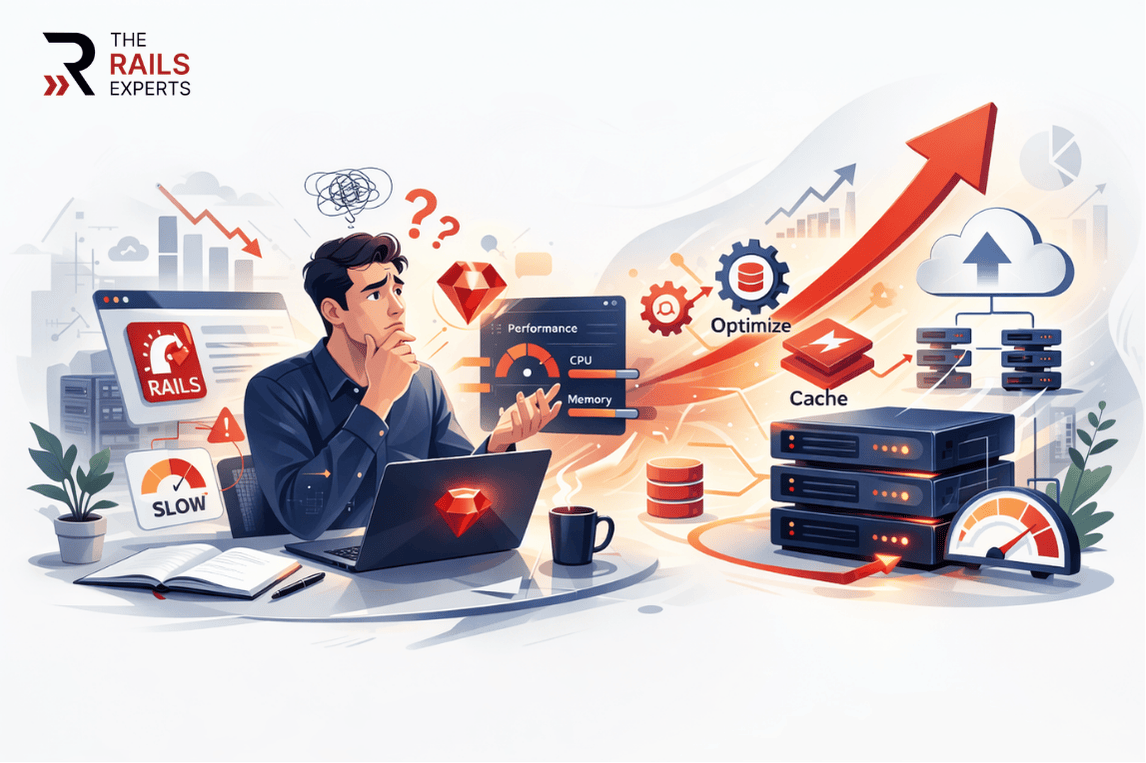
Is your Ruby on Rails application slowing down as traffic increases? Many growing businesses face this challenge. Slower page loads, delayed background jobs, and inconsistent performance during peak hours can quietly affect user experience and revenue. Without a clear scalability plan, growth can become a technical risk.
Scalability in Ruby on Rails goes beyond adding servers. It requires strong architecture, efficient databases, effective caching, and proper infrastructure alignment. With the right approach, your application can handle increasing demand without compromising performance.
In this article, you will learn what drives Rails scalability and the practical steps you can take to strengthen your application for sustainable growth.
What factors determine the scalability of my Ruby on Rails application?
Improving scalability starts with understanding what influences it. Several architectural and operational factors determine how well your Rails application performs under increasing demand.
Application architecture design
A modular, loosely coupled architecture allows components to scale independently. Clear separation of responsibilities improves flexibility and supports growth without affecting the entire system.
Tightly coupled systems create dependencies that make scaling complex and risky. A clean architecture improves resilience and long-term maintainability.
Database structure and data growth
As data grows, poor schema design and missing indexes slow performance. Inefficient queries become more visible under higher traffic.
Proper indexing and optimized queries maintain consistent performance. PostgreSQL documentation provides detailed guidance on index types and optimization strategies commonly used in Rails applications. Planning for data growth early prevents future bottlenecks.
Caching implementation
Caching reduces repeated database access and improves response time. Well-structured caching layers help applications handle higher traffic efficiently.
However, incorrect cache invalidation can cause stale data issues. A balanced caching strategy supports both performance and accuracy.
Infrastructure and hosting environment
Infrastructure configuration directly affects scalability. Load balancing, auto-scaling, and resource allocation must match application demand.
Even optimized code can struggle in a poorly configured environment. Proper infrastructure planning ensures stable performance during growth.
Background processing and asynchronous workflows
Heavy tasks should run in background jobs instead of blocking user requests. Tools such as Sidekiq are widely adopted in Rails ecosystems for managing asynchronous processing reliably at scale. This keeps response times fast during traffic spikes.
Asynchronous workflows improve reliability and prevent system overload during high demand.
Monitoring and observability
Monitoring provides visibility into performance trends and system health. Without it, scalability issues remain unnoticed until they impact users.
Continuous tracking enables proactive scaling and informed optimization decisions.
Steps to improve Ruby on Rails application scalability
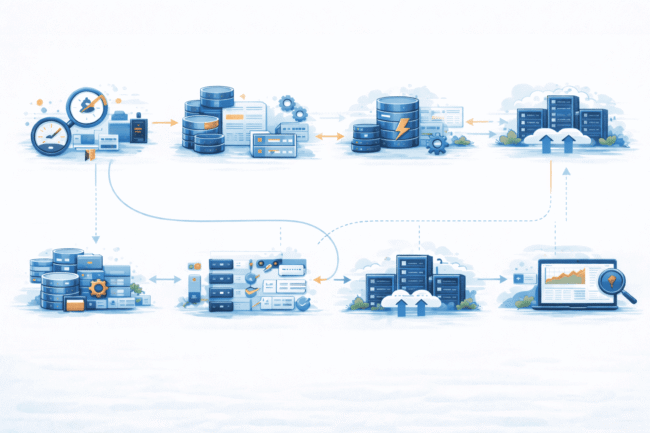
1. Identify bottlenecks before scaling infrastructure
Before increasing server capacity or upgrading instances, you need full visibility into performance constraints. Scaling without identifying bottlenecks often raises costs without fixing the underlying issue. Use monitoring tools to track slow endpoints, database latency, memory usage, and CPU spikes. Review logs to uncover patterns during peak traffic. When you clearly understand where slowdowns occur, you can make targeted improvements instead of reactive changes.
- Analyze response time distribution across endpoints
- Monitor CPU, memory, and I/O utilization trends
- Review application and server logs during peak traffic
- Use profiling tools to trace slow code execution paths
2. Optimize database performance
The database is one of the most common scalability constraints in Rails applications. As traffic increases, inefficient queries create compounding delays. Review slow query logs and improve indexing strategies. Eliminate N+1 queries through eager loading and ensure only required columns are retrieved. Evaluate whether complex joins can be simplified. Early database optimization prevents performance degradation under growth.
- Add indexes to frequently filtered or joined columns
- Enable query logging and review slow query reports
- Replace repeated queries with optimized eager loading
- Archive or partition large datasets when necessary
3. Implement a layered caching strategy
Caching reduces repetitive database access and expensive computations. Apply page caching for static content, fragment caching for reusable components, and low-level caching for heavy queries. Ensure cache invalidation policies are clearly defined to avoid stale data. A well-planned caching strategy allows your application to handle higher traffic without overloading core systems.
- Cache frequently requested queries or API responses
- Use fragment caching for common UI components
- Configure appropriate cache expiration policies
- Monitor cache hit rates and adjust accordingly
4. Tune application and server configuration
Rails scalability depends heavily on proper server configuration. Worker processes, thread counts, and database connection pools must align with traffic demands. Poor configuration can lead to resource exhaustion or idle capacity. Regular performance tuning ensures your infrastructure supports real-world concurrency safely and efficiently.
- Adjust worker and thread settings based on load testing results
- Align database connection pool size with concurrency needs
- Configure timeouts to prevent stalled requests
- Benchmark configuration changes before deploying to production
5. Offload heavy tasks to background jobs
Time-intensive operations should not block user requests. Move tasks such as email sending, report generation, file processing, and external API calls into background job queues. Asynchronous processing keeps response times fast and improves reliability during traffic spikes.
- Use background job frameworks for asynchronous processing
- Separate real-time actions from batch operations
- Monitor job queue latency and retry failures safely
- Prioritize critical jobs during peak traffic periods
6. Introduce horizontal scaling early
Relying only on vertical scaling has limits. Horizontal scaling distributes traffic across multiple instances using load balancing. Cloud providers such as AWS document auto-scaling strategies that dynamically adjust capacity based on traffic demand.
This improves availability, resilience, and traffic distribution. By spreading workload across servers, you reduce single points of failure and improve fault tolerance.
- Implement load balancing across application instances
- Configure auto-scaling policies based on traffic thresholds
- Ensure stateless application design for easier scaling
- Test failover scenarios to validate resilience
7. Conduct load and stress testing
Load testing simulates expected traffic levels to measure system behavior under concurrency. Stress testing pushes the system beyond anticipated limits to reveal breaking points and recovery behavior. These exercises provide clarity on true system capacity before real users experience disruption.
- Simulate realistic user behavior and traffic patterns
- Identify performance degradation thresholds
- Measure response times under peak concurrency
- Document breaking points and recovery metrics
8. Monitor continuously and proactively
Scalability is an ongoing process. Monitor response times, database health, memory usage, and background job performance consistently. Establish alerts for abnormal patterns so issues can be addressed early. As your application evolves, monitoring ensures scalability remains aligned with growth.
- Set automated alerts for latency spikes
- Track long-term performance trends
- Monitor database throughput and replication health
- Review system metrics after feature releases
A sustainable approach to Rails scalability
Improving Ruby on Rails application scalability is an ongoing process rather than a one-time upgrade. It requires visibility, continuous optimization, architectural clarity, and disciplined monitoring.
When database queries are efficient, caching is structured correctly, infrastructure is tuned, and performance is consistently observed, your application becomes capable of supporting sustained growth without compromising user experience.
Scalability should support business expansion, not create operational stress. By addressing these factors proactively, you ensure that growth strengthens your application instead of exposing its weaknesses.
If you would like a structured scalability assessment or expert guidance tailored to your application, get in touch with our team to discuss the next steps toward building a growth-ready Rails system.
