Is your Ruby on Rails application becoming harder to manage as it grows? What once felt fast and reliable may now show signs of strain. Pages load slower, releases feel stressful, and recurring bugs delay progress. Security fixes become reactive instead of planned.
As the product evolves, technical debt builds quietly in the background. Maintenance costs increase and innovation slows. Small technical issues begin to affect user experience and overall business momentum.
Ruby on Rails is designed to support scalable growth. The real challenge is usually not the framework but the way the application was architected and how consistently code quality was maintained as new features were added.
In this guide, you will learn how code quality impacts long term success, how to identify early warning signs, and what practical steps you can take to strengthen your application for stable and sustainable growth.
How does poor code quality increase long term costs?
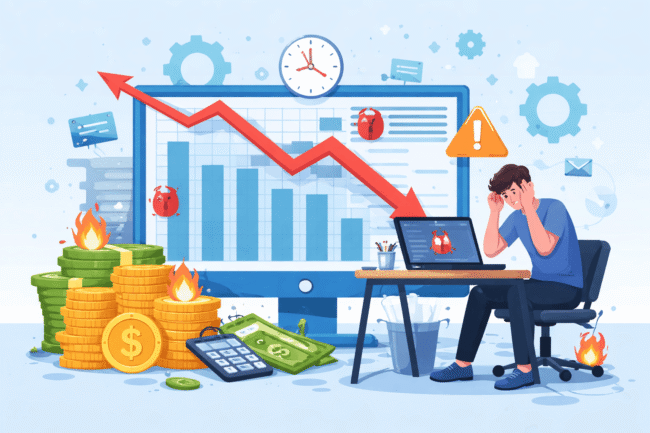
Shortcuts during development often feel efficient in the beginning. Over time, those shortcuts compound.
Poorly structured Rails applications typically experience:
- Delayed releases due to unexpected bugs
- Frequent hotfixes and emergency deployments
- Higher support and debugging costs
- Repeated performance optimization efforts
Instead of investing in product improvements or customer experience, your engineering budget gets redirected toward maintenance. This is how technical debt silently erodes profitability.
Validating code quality helps prevent this cycle before it becomes expensive.
What risks emerge when Rails architecture is inconsistent?
Inconsistent architecture leads to unpredictability. When design patterns vary across modules or responsibilities are unclear, the system becomes fragile.
Developers struggle to understand dependencies. Changes in one area unintentionally affect others. Testing becomes unreliable. Over time, confidence in the system declines.
A structured Rails application, on the other hand, follows clear conventions. Modular components reduce risk. Predictable patterns simplify debugging and upgrades.
How does code quality influence performance and scalability?
Scalability is not just about infrastructure. It is about how efficiently your application processes requests, queries databases, and manages background jobs.
Well engineered Rails applications handle increased traffic without dramatic performance drops. They manage data growth without degrading response times.
When code is optimized and structured properly, scaling becomes manageable. When it is not, every growth milestone introduces new instability.
Why is security validation essential in Rails applications?
Security vulnerabilities often originate from weak implementation rather than from the framework itself.
Strong code quality ensures that authentication flows are secure, access controls are clearly defined, and sensitive data is handled properly. This becomes especially important when compliance requirements apply, such as the General Data Protection Regulation (GDPR) – Official European Commission page and the Health Insurance Portability and Accountability Act (HIPAA) – Official U.S. Department of Health & Human Services overview, both of which outline strict standards for data protection, privacy, and information security.
Ignoring security best practices increases exposure to data breaches, regulatory penalties, and reputational damage. Regular code quality validation significantly reduces these risks and strengthens long term system resilience.
What are the warning signs of technical debt in a Rails application?
If you are unsure about your system’s health, look for these indicators:
- Are deployments becoming slower and more stressful?
- Do the same categories of bugs keep resurfacing?
- Is onboarding new developers taking longer than expected?
- Does adding a simple feature require extensive rework?
- Are performance issues appearing with moderate user growth?
These signals suggest that quality validation may be overdue.
How can you evaluate Ruby on Rails code quality effectively?
A structured evaluation typically includes several layers.
Code reviews
- Identify duplicated logic and eliminate unnecessary repetition across modules
- Detect inconsistent naming conventions and coding patterns early
- Highlight architectural drift before it impacts scalability
- Encourage shared ownership and knowledge transfer within the team
- Improve overall readability and maintain long term maintainability
Automated testing
- Prevent regressions when new features or fixes are introduced
- Increase deployment confidence through reliable unit and integration coverage
- Validate business logic across edge cases and failure scenarios
- Reduce dependency on manual testing cycles
- Support faster, safer release iterations
Static analysis tools
- Detect code complexity and maintainability risks early
- Identify security vulnerabilities and unsafe coding practices
- Enforce consistent style and framework conventions
- Surface performance inefficiencies before production impact
- Provide measurable quality benchmarks for continuous improvement
Architectural assessment
- Evaluate database design for scalability and query efficiency
- Review service boundaries and responsibility separation
- Assess background job processing and asynchronous workflows
- Analyze caching strategies for performance optimization
- Ensure system design supports long term growth and feature expansion
Industry guidance from the Ruby on Rails Foundation reinforces the importance of sustainable development practices within the Rails ecosystem.
How often should you validate your Rails codebase?
Code quality validation should not be a one time event.
For growing SaaS platforms, periodic reviews every few months help maintain architectural consistency. For enterprise systems with heavy integrations, structured audits before major feature expansions reduce risk.
The goal is not perfection. The goal is prevention.
How much does poor Rails code quality really cost your business?
Poor Ruby on Rails code quality rarely shows its full impact at the start. Early issues seem small, but they gradually create deeper structural problems as the application grows.
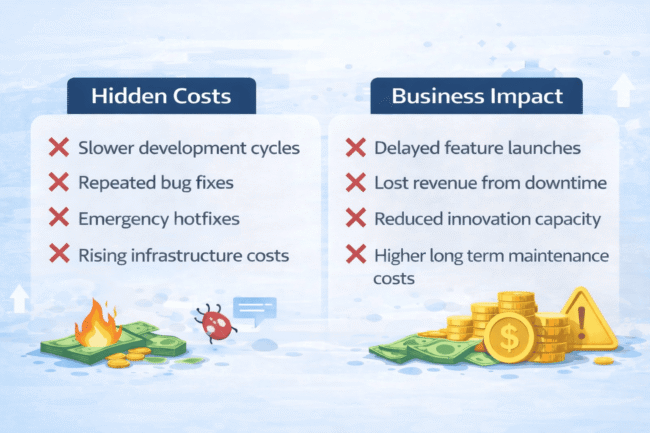
Over time, these weaknesses lead to slower releases, recurring bugs, emergency fixes, and rising infrastructure costs. Teams begin spending more time maintaining the system than improving it.
When that happens, the financial impact is already visible through delayed features, reduced innovation, and lost revenue opportunities. Addressing these issues early protects long term growth.
Why proactive Ruby on Rails code quality validation protects long term growth
Validating Ruby on Rails code quality is not about technical idealism. It is about ensuring your product remains stable, secure, and scalable as your business grows.
When architecture is clean and standards are enforced, releases become predictable, teams collaborate more effectively, and customers experience fewer disruptions.
If you suspect your Rails application may be accumulating technical debt, a structured code review or audit can provide clarity before risks turn into costly problems.
Taking action today protects long term product value tomorrow.
If you would like an objective assessment of your Ruby on Rails application, feel free to get in touch with our team. We can help you evaluate your current codebase, identify risks, and outline practical steps to improve stability, performance, and maintainability.
